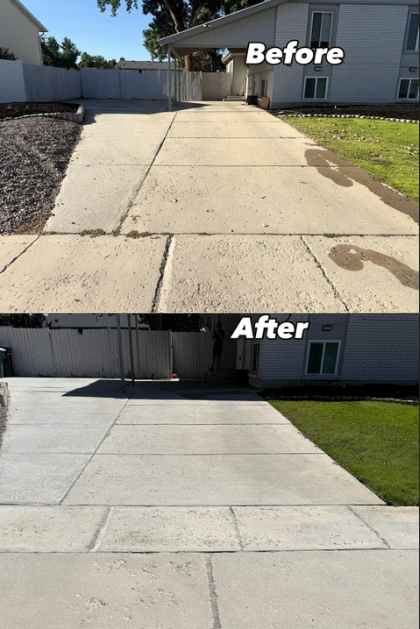
Short answer: yes. Long answer: only if you’re doing it wrong — and more people are doing it wrong than you’d think.
By LHS Powerwash·Serving Sandy, UT & surrounding areas · 6 min read
Let’s be real for a second. You’ve seen someone blast their driveway with a pressure washer, watched the grime disappear in seconds, and thought: “That looks amazing. I need one of those.” And look, we get it. There’s something deeply satisfying about watching years of dirt vanish in a single pass.
But here’s the thing nobody talks about: concrete pressure washing damage is a very real problem — and it’s usually invisible until it’s too late. That driveway that looked sparkling clean after a DIY session? It may have aged five years in an afternoon.
So let’s dig into the real science (and some hard-learned lessons) behind cleaning concrete safely.
Why concrete isn’t as tough as it looks
Concrete seems indestructible. It holds up bridges, skyscrapers, and your mother-in-law’s holiday casserole dish when she drops it. But on a microscopic level, it’s a porous material full of tiny air pockets and aggregate particles — and water under high pressure can force its way into those pores with surprising aggression.
The result? Pressure washer etching on concrete — those faint (or not-so-faint) lines, streaks, and rough patches left behind when the surface layer gets stripped away. Once the cement paste is gone, the underlying aggregate is exposed and the concrete becomes more susceptible to cracking, freeze-thaw damage, and staining all over again. Congratulations — you’ve made your driveway worse than when you started.
Heads up
New concrete is especially vulnerable. If your driveway was poured in the last 12 months, wait before pressure washing — the surface hasn’t fully cured and is far easier to etch and scar.
What PSI should you actually use?
This is probably the most googled question in the world of concrete cleaning, and the answer isn’t as simple as a single number. The best PSI for cleaning concrete depends on the age of the concrete, its condition, and what you’re trying to remove.
500–800
Light rinsing
General dust and loose debris. No real cleaning power for stains.
1,000–1,500
Light-duty cleaning
Good for newer or decorative concrete. Minimizes etching risk.
2,000–3,000
Standard driveways
The sweet spot for most residential concrete. Use a wide-angle nozzle.
3,500+
Industrial / danger zone
Only for heavily stained, aged commercial concrete. In the wrong hands: bye-bye surface.
The nozzle angle matters just as much as the PSI. A zero-degree (red) nozzle at 2,500 PSI concentrates all that force into a pencil-thin stream — it will absolutely etch your concrete. A 25- or 40-degree nozzle spreads the pressure out and is far safer for most surfaces. Think of it like the difference between jabbing concrete with an ice pick versus patting it with a wide paintbrush.
So how do you clean concrete without damaging it?
The good news: knowing how to clean a concrete driveway without damage isn’t rocket science. It just requires a little patience and the right technique.
Keep the wand moving. Never hold the spray in one spot. That’s how you get etching. Keep a consistent sweeping motion, like you’re mowing a tiny lawn made of water.
Start with a pre-treatment. For oil stains, mildew, or algae, apply a concrete-safe degreaser or detergent first. Let it dwell for 5–10 minutes. This does a lot of the work before the water ever touches the surface — meaning you can use lower pressure to rinse it away.
Maintain distance. Keep the nozzle at least 6–12 inches from the surface. The closer you get, the more concentrated the force. If you have to get real close to lift a stain, you probably need a better chemical pre-treatment — not more pressure.
Seal when you’re done. A quality concrete sealer after cleaning protects the surface and makes future cleanings dramatically easier. It’s the concrete equivalent of putting a screen protector on your phone before you drop it — not after.
Soft washing vs. pressure washing concrete — what’s the difference?
You’ve probably heard the term soft washing tossed around. So what’s the actual difference when it comes to soft washing vs. pressure washing concrete?
Pressure washing
- Relies on high water pressure
- Great for heavy grime, oil, and tire marks
- Higher risk of etching if done wrong
- Fast and satisfying (we won’t lie)
Soft washing
- Low pressure + cleaning solution
- Better for algae, mold, and mildew
- Safer for older or decorative surfaces
- Longer-lasting results (kills, not just moves)
For most residential concrete driveways, the ideal approach is actually a hybrid: use a biodegradable detergent or degreaser at low pressure for the initial treatment, then rinse with moderate pressure (1,500–2,500 PSI) and a surface cleaner attachment. The surface cleaner is a game-changer — it spins the water in an even circular pattern, which eliminates streaking and dramatically reduces etching risk.
Pro tip from LHS Powerwash
We almost always combine soft washing techniques with moderate pressure on concrete jobs here in Utah. The freeze-thaw cycles we get through winter mean local driveways often have micro-cracks that are invisible to the eye — hammering them with 3,500 PSI is a recipe for expensive repairs down the road.
When to call a pro (and no, we’re not just saying that)
Look, we know how this sounds coming from a pressure washing company. But there genuinely are situations where DIY concrete washing goes sideways fast — and the repair costs make the $200 you saved on hiring someone look pretty silly in hindsight.
Call a professional if your driveway has visible cracks or spalling, if you’re dealing with deep oil stains that have been sitting for months, if the concrete is older and you’re not sure of its condition, or if you’re cleaning decorative, stamped, or stained concrete (these surfaces are extremely easy to damage with the wrong technique).
At LHS Powerwash, we assess every concrete surface before we touch it. We look at age, condition, stain type, and surface texture — and then we choose the right combination of pressure, temperature, and chemistry for that specific job. That’s the difference between cleaning your driveway and accidentally giving it a sandblasting.
The bottom line
Can pressure washing damage concrete? Absolutely — but only if you’re using the wrong PSI, the wrong nozzle, the wrong distance, or skipping the pre-treatment step. Done correctly, pressure washing is one of the best ways to restore and maintain your concrete surfaces for years to come.
The goal isn’t just a clean driveway today. It’s a driveway that looks great and holds up for the next decade. A little know-how (or a call to the right crew) makes all the difference.
Ready for a clean that doesn’t cost you your driveway?
LHS Powerwash serves Spanish Fork, UT and the surrounding area. We’ll assess your concrete and get it clean the right way — no etching, no streaks, no surprises. We’ll utilize professional grade cleaning agents, a surface cleaner, and restore your driveway to it’s original glory! Get tips for my driveway ↗